

By Andreas | Viterna.atUpdated: 24 September 2026Reading time: approx. 9 minutes
"Where did I put the keys?" If you know that sentence, you are in good company.
Names on the tip of your tongue. The reason you just walked into the kitchen. The word that simply will not come. Such lapses are part of everyday life, and they become more frequent from midlife on.
That is no cause for concern, but it is a good reason to look at what your brain actually needs. Because hardly any organ responds as directly to sleep, exercise and diet as your head. In this article we explain what changes over the years, which four building blocks carry mental fitness, which nutrients play a proven role and what you can expect from plants like brahmi and ginkgo.

Symbolic image: AI-generated
Your brain in three numbers
Your brain weighs around 1.4 kilograms, about 2 percent of your body weight. Yet at rest it uses around 20 percent of your total energy, more than any other organ. And after fatty tissue it is the fattiest tissue in your body: around 60 percent of its dry mass is fat, above all in the sheaths of the nerve cells and in the membranes through which nerve cells talk to each other. One of the most important of these fatty acids is DHA, an omega-3 fatty acid that your body makes only in small amounts itself and that therefore has to come from food.
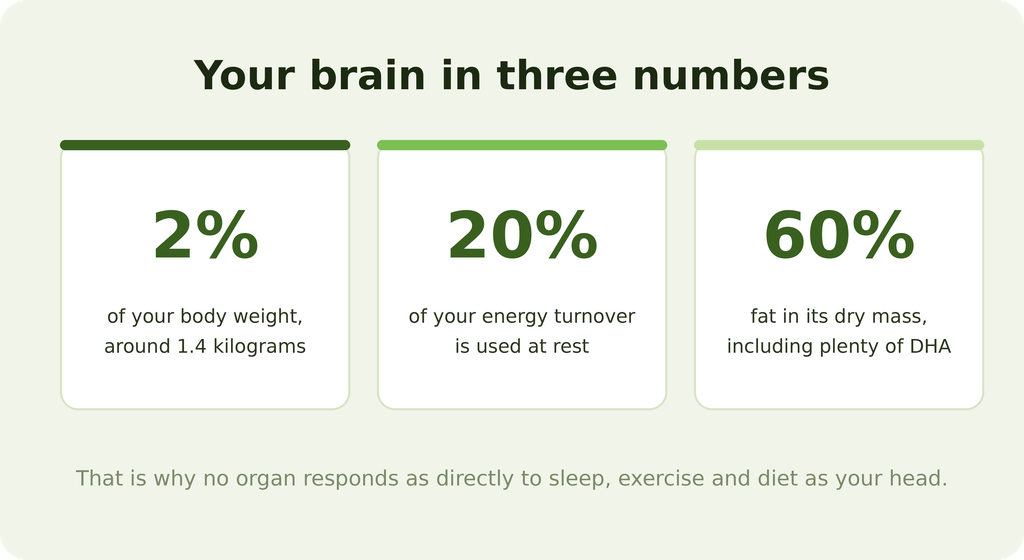
What follows from this: An organ that turns over so much energy needs a reliable supply of energy and of the vitamins that keep energy metabolism running. An organ that consists to such a large extent of fat needs the right fats. And an organ that tidies up at night needs sleep.
Forgetting is normal: what changes over the years
First, some reassurance. That memory works differently from midlife on is normal and well researched. What slows down is above all speed: new information takes longer to stick, and retrieval takes a moment longer. The word is there, it just arrives later. What is preserved, or even improves, is vocabulary, experience and the ability to see connections. Older people often solve problems differently, but not worse.
The underrated factor: attention. Much of what looks like forgetting was never properly stored in the first place, because the head was busy with three other things while the keys were being put down. Lack of sleep, constant stress and permanent interruptions often affect memory more than your year of birth does. The good news: these are exactly the dials you can turn.
The four building blocks of mental fitness
Research agrees on few topics as much as on this one: mental fitness is not a single switch but the interplay of four building blocks that reinforce each other.

The best-documented building block of all. Brisk walking, cycling, swimming, gardening: anything that noticeably raises your pulse improves blood flow and the supply to the brain. It does not have to be sport in the narrow sense; the walk to the shops counts.
During sleep the brain sorts what came in during the day and moves the important things from short-term to long-term memory. Anyone who regularly sleeps too little learns measurably worse the next day.
The brain stays malleable into old age; specialists call this neuroplasticity. But it only builds new connections where it is challenged: a new language, an instrument, a craft, a different route to work, a board game with friends. Crosswords you have been solving for 20 years are routine, not training.
No substitute for the first three building blocks, but their foundation. Without DHA there is no building material, without B vitamins energy metabolism does not run smoothly, without iron, iodine and zinc you lack nutrients that the EU explicitly links to cognitive function. More on that in a moment.

Symbolic image: AI-generated
Which nutrients play a proven role
Here we draw a clean line between what the EU has authorised as a claim after scientific assessment and what manufacturers would like to claim. Authorised health claims exist for these nutrients, each quoted word for word in the box:
DHA (omega-3)
"DHA contributes to the maintenance of normal brain function."
B vitamins
"Vitamins B1, B3, B6, B12 and biotin contribute to normal psychological function." "Pantothenic acid contributes to normal mental performance."
Iron, zinc and iodine
"Iron, zinc and iodine contribute to normal cognitive function."
What is deliberately missing from these boxes: a statement like "improves memory" or "boosts concentration". No such claim exists for any food or food supplement, and you will not read one here. The authorised claims describe that a nutrient is needed for normal function. Anyone who is adequately supplied gains nothing from more. Anyone who is short, and with DHA, B12 and iron that is more common than you would think, closes a gap.
Brahmi, ginkgo and co: what plants can and cannot do
Two plants are almost always mentioned when it comes to the head. Legally, both, like all botanicals, are "on hold" in the EU: the claims applied for have been neither authorised nor finally rejected for years. We are therefore allowed to say what a plant is traditionally used for, but not that it has an effect.
Bacopa monnieri, water hyssop
One of the central plants of Ayurveda for centuries, traditionally used there to support concentration and learning. Scientifically more interesting than most other plants: several smaller placebo-controlled studies in healthy adults with standardised extract over 12 weeks, with mixed but encouraging results.
Ginkgo biloba, the temple tree
One of the most studied plants in Europe since the 1960s; the leaf extract is traditionally associated with circulation. In healthy people the picture is less clear than with brahmi. Anyone taking anticoagulants should clarify the combination beforehand.
Our assessment: Both plants are a legitimate addition for anyone who wants to give them a chance, but no shortcut past the four building blocks. And both need time: with brahmi, tradition allows 8 to 12 weeks of daily intake.
3 myths fact-checked
Myth 1"You cannot learn anything new after 60."
Fact: The opposite is established. The brain forms new connections into old age; it just needs a reason. People who start an instrument at 70 learn more slowly than at 20, but they learn. And the learning itself is the training.
Myth 2"Brain-training apps make you smart."
Fact: Only to a limited extent. If you practise an app task, you get better at exactly that task; the transfer to everyday life is small. More effective is anything that involves several senses, movement and other people: dancing, a choir, a language course, chess against a real opponent.
Myth 3"A capsule replaces the walk."
Fact: No. Nutrients are building material, not instructions. Anyone who supplements DHA and B vitamins but sits, sleeps badly and learns nothing new has delivered the material without anyone building. Conversely: anyone who moves, sleeps well and learns gets the most out of a good supply.
Taking it properly: daily, with a meal, with patience
Omega-3 fatty acids are fat-soluble and are best absorbed with a meal. Whether from fish oil or algae oil is a question of diet: algae oil delivers the same DHA that fish also get from algae, just without the detour. Allow several weeks until the DHA share in the cell membranes has changed.
A B complex goes well with breakfast, because B vitamins are involved in energy metabolism and some people find them stimulating in the evening. They are water-soluble; any excess is excreted. Vitamin B12 becomes a must, not an option, on a vegan diet.
Both traditionally daily with a meal, with patience. With ginkgo: anyone taking anticoagulants should clarify the combination beforehand, because ginkgo extract can increase the tendency to bleed.
Iron (ferritin) and vitamin B12 can be determined in blood. Anyone who knows their value supplements deliberately rather than on suspicion.
Which product suits you?
We have sorted the products by building block so you can see what fits your situation. The claims mentioned refer to the nutrient in each case, not to the product.
Omega-3 from fish oil
Concentrated Golden Omega fish oil, an Austrian brand made to GMP guidelines, with vitamin E to protect against oxidation.


DHA contributes to the maintenance of normal brain function (from 250 mg a day).
Omega-3 from algae oil, vegan
The same DHA that fish also get from algae, just without the detour and without a fishy taste.


DHA contributes to the maintenance of normal brain function. Vitamin D contributes to the maintenance of normal bones.
Omega-3 from krill oil
Krill, the small shrimp from the Antarctic Ocean, delivers EPA and DHA bound to phospholipids, the form in which they sit in your cell membranes, and naturally brings along the red pigment astaxanthin, which protects the oil from oxidation. The downside: less omega-3 per capsule than fish or algae oil, so you need more capsules for the same amount of DHA, and krill oil is more expensive.


EPA and DHA contribute to the normal function of the heart (from 250 mg a day).
B vitamins
Best in the morning with breakfast, daily at the same time. On a vegan diet B12 is a must, not an option.


Vitamins B1, B6 and B12 contribute to normal psychological function, vitamins B6 and B12 to the reduction of tiredness and fatigue, pantothenic acid to normal mental performance.
Brahmi and ginkgo
Traditional plants, legally "on hold": we name the traditional use but promise no effect. Both need 8 to 12 weeks.


Anyone taking anticoagulants should clarify the combination with ginkgo beforehand.
Combinations for the head
Ready-made formulas of plant extracts, phospholipids and B vitamins.


Pantothenic acid contributes to normal mental performance.
For energy metabolism
NADH, coenzyme 1, and Q10 are part of energy production in the mitochondria. More in our Q10 guide.


Frequently asked questions about memory and mental fitness
Is it normal that I remember names less well than I used to?
Yes. From midlife on, storing and retrieving new information takes longer; this is well researched and normal. Vocabulary, experience and judgement are preserved. Often, attention is behind the forgetting: what was never properly stored cannot be retrieved either.
How much DHA do I need a day?
The authorised claim on brain function applies from 250 milligrams of DHA a day. That corresponds to about one portion of oily sea fish a day or one to two capsules of fish or algae oil. Anyone who rarely eats fish is usually well below that.
Fish oil or algae oil?
Both deliver DHA and EPA. Algae oil comes from the microalgae from which fish also get their omega-3 and is the choice for a vegan diet or for anyone who wants to avoid a fishy taste. Fish oil is usually cheaper. What matters is the amount of DHA per daily dose, not the source.
Does brahmi really help with learning?
Brahmi is traditionally used in Ayurveda to support concentration and learning. Smaller studies with standardised extract over 12 weeks show mixed but encouraging results. No claim is authorised in the EU; the assessment has been pending for years. If you try it, allow 8 to 12 weeks.
What helps more: exercise or supplements?
Exercise. It is the best-documented single factor for mental fitness at any age. Nutrients are the foundation on which exercise, sleep and learning build, not a substitute for them.
From when should I supplement B12?
On a vegan diet always, because B12 occurs practically only in animal foods. In older age, absorption from food declines, so a look at the blood value is worthwhile. Vitamin B12 contributes to normal psychological function and to the reduction of tiredness.
Conclusion: four building blocks, one head
Your brain is the organ that uses the most energy, consists largely of fat and forms new connections into old age. It therefore responds directly to what you do every day. Authorised claims exist for the nutrients mentioned; plants like brahmi and ginkgo have a long tradition and an open assessment. Our advice: start with the building block that is weakest for you. For most people, that is not the capsule.
Takeaways
- Exercise: 30 minutes, daily if possible
- Sleep: 7 to 8 hours at regular times
- Learn new things: unfamiliar, and keep at it
- Nutrients: DHA from 250 mg, B vitamins, iron, iodine, zinc
More knowledge like this?
Every two weeks our newsletter explains a health topic like this one: clearly, with a tip for everyday life and matching recommendations from our range.
Note: This article is for general information and does not replace medical advice. The health claims mentioned refer exclusively to the respective nutrients (DHA, B vitamins, iron, zinc, iodine) and their contribution to normal body functions; no authorised claims exist for botanicals such as brahmi and ginkgo. Food supplements are not a substitute for a balanced and varied diet and a healthy lifestyle. Do not exceed the recommended daily intake.