

By Andreas | Viterna.at · Last updated: 9 September 2026 · Reading time: approx. 7 minutes
"I get enough sleep, yet I'm tired all day long." We hear and read this sentence from our customers surprisingly often, especially now that the days are getting shorter again. And our first question back is almost always the same: when was your iron last checked? Because behind persistent weariness there is, more often than many think, a low iron level. In this article we explain what iron does in your body, what the lab value ferritin reveals, how to spot a deficiency and how to take iron so that it actually arrives.

Symbolic image: AI-generated
What does iron do in your body?
Iron is a trace element: your body needs only a few milligrams a day, yet very little works without them. Most of your iron, around 70 %, works inside the red blood cells: there it forms the core of haemoglobin, the red blood pigment that picks up oxygen in the lungs and carries it to every single cell. The rest is spread across your muscles, the enzymes of your energy metabolism and a reserve we will come to in a moment.

This also makes clear why tiredness is the leading sign when iron is lacking: less iron means less oxygen transport, and less oxygen means less energy in your cells. The European food safety authority has officially authorised several statements on iron: iron contributes to the reduction of tiredness and fatigue, it supports normal oxygen transport in the body, the normal formation of red blood cells and haemoglobin, a normal energy-yielding metabolism and even normal cognitive function, meaning clear thinking and concentration. These are not advertising slogans but the few statements that may legally be made about iron in Europe, because the evidence supports them.
Worldwide, low iron is the most common nutrient deficiency of all. The World Health Organization estimates around two billion people are affected. One reason is that the body does not absorb iron particularly well: of what is on your plate, only around 10 to 15 % actually makes it into your blood.
Ferritin explained simply: your iron savings account
When people talk about their "iron level", most mean the haemoglobin from a standard blood count. The more interesting value, however, is called ferritin, and you can picture it as a savings account: ferritin is the storage protein in which your body puts iron aside for leaner times. If more iron keeps going out than coming in, the body quietly empties this savings account first. Haemoglobin often stays normal for a long time.
This is exactly why many people already feel weary, exhausted and unfocused although "the blood count was fine": the store is already empty, only the everyday account is not. Professionals call this a latent iron deficiency.
If you are persistently tired, the best step is to have your ferritin measured specifically: a simple lab value that can easily be included in any blood test. Measure first, then act: that is the right order with iron, because too much iron is not desirable either.
What is a good ferritin level?
Reference ranges differ depending on the laboratory, your age and your sex. As a rough guide for adults:
- Women (approx. 16–50 years): around 15 to 150 µg/l; values below 15–30 µg/l usually already count as empty stores.
- Men: around 30 to 300 µg/l (up to 400 µg/l depending on the laboratory).
- Children and older people: have their own reference ranges; what counts is always the range stated on your lab report.
The crucial distinction is between "just about normal" and "well filled": below 30 µg/l the stores are practically empty, even if the blood count is still unremarkable. Between 30 and 50 µg/l lies a grey zone: if you have complaints in this range, have the value assessed by your doctor. The goal is therefore a comfortable cushion clearly above the lower limit, not merely reaching the minimum. Strongly elevated values (above 300 µg/l) are no reason to celebrate, by the way: ferritin also rises with inflammation and infections and can point to iron overload.
Typical signs that iron may be lacking
Empty iron stores rarely show up as a single symptom. They appear as the sum of many small signals:
- Persistent tiredness and exhaustion that does not go away even after enough sleep. The most common sign by far.
- Trouble concentrating, the famous "brain fog", because the brain also depends on good oxygen transport.
- Pale skin, often first visible on the inside of the lower eyelids.
- Brittle nails and increased hair loss: hair roots and nail beds are among the tissues where the body economises first.
- Cracked corners of the mouth and dry skin.
- Cold hands and feet along with reduced stamina: climbing stairs feels more strenuous than it used to.

Symbolic image: AI-generated
Important context: every one of these signs can also have other causes, from too little sleep and stress to an infection that is still wearing off. But if several points apply to you, that is a good reason to measure your ferritin instead of guessing any longer.
Who should pay particular attention to iron
- Women up to menopause. Menstruation means a regular loss of iron; the daily requirement is therefore considerably higher than for men. No coincidence that empty iron stores are so common in women between 20 and 50.
- People on a vegetarian or vegan diet. Plant foods certainly contain iron (pulses, oats, pumpkin seeds, beetroot), but in a form the body absorbs less well than the iron from meat. Eating purely plant-based does not automatically mean a deficiency, but it is worth keeping an eye on your level and helping absorption along (the orange juice trick below is doubly valuable here).
- Seniors, including and especially at 65, 70 or 80+. With age, people often eat less and less varied food, the stomach produces less acid, and some medications additionally slow iron absorption. Persistent tiredness is then easily dismissed as "just age". Yet quite often it is simply an empty iron store, and that can be fixed. Anyone who wants to stay mobile and independent should have the value checked regularly.
- Endurance athletes. Sweating, increased blood formation and the impact of running all raise consumption.
- Blood donors. Every donation takes 200 to 250 milligrams of iron. That is a sizeable withdrawal from the savings account, and it wants to be topped up again.
- Pregnant and breastfeeding women have a greatly increased requirement; here, supply belongs under medical guidance as a matter of principle.
How to take iron: the orange juice trick
With iron, what matters is not only whether you take it but above all how. Hardly any other nutrient reacts so sensitively to its companions:
- The orange juice trick: always combine iron with vitamin C. This too is an officially authorised statement: vitamin C increases iron absorption. A glass of orange juice, a squeeze of lemon or half a bell pepper with your meal makes noticeably more of the same amount of iron. Many good products therefore have vitamin C built in already, for example from the acerola cherry.
- Keep a gap to coffee, black tea and green tea. Their tannins bind iron in the gut before it can be absorbed; in extreme cases a large share is lost. You do not have to give up your coffee: simply keep around two hours between coffee and your iron.
- Dairy products slow things down too. Calcium competes with iron for absorption; a latte with your iron supplement is doubly unfavourable.
- Morning is a good time. Iron is absorbed best on an empty stomach. If that does not agree with you, take it with a small, dairy-free meal. Better slightly less absorbed than not taken at all.
- Less is often more. The body absorbs smaller amounts of iron proportionally better than large ones all at once. Moderately dosed products, taken regularly, are the more sensible route for most people than high-dose crash campaigns.
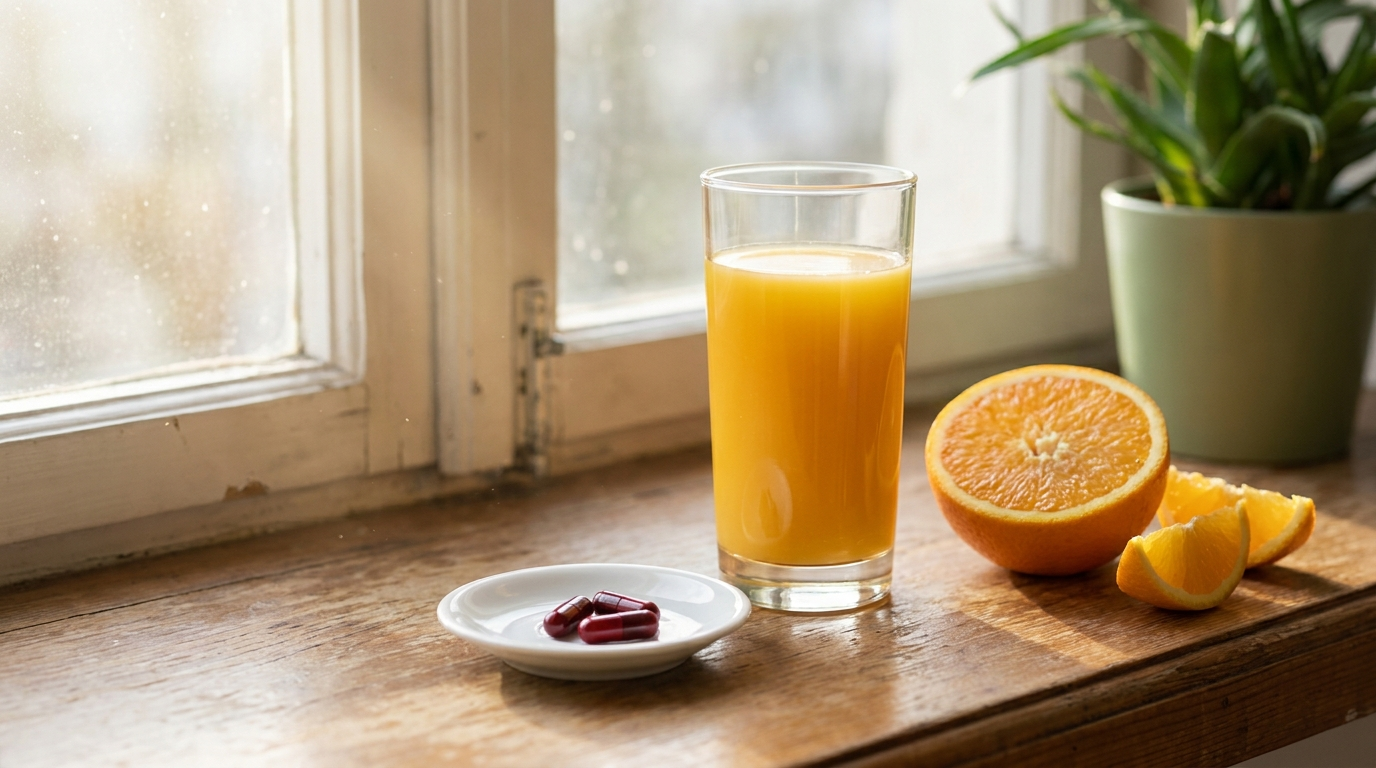
Symbolic image: AI-generated
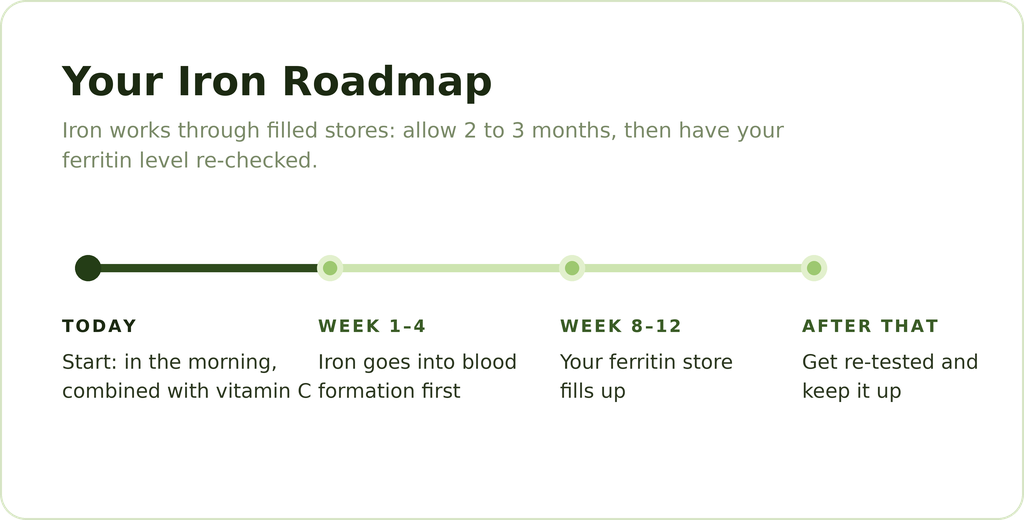
And then it takes one thing above all: patience. Iron stores empty over months, and they fill up over months too. In the first weeks the iron flows mainly into blood formation; the ferritin savings account only fills up after that. Allow two to three months of consistent intake, then have the value re-checked. That way you see in black and white what has changed and whether you should keep going.
One honest word in addition: for many people, iron is not a one-off project. As long as the reason for the increased consumption remains (the monthly period, the plant-based diet, the intensive training), even freshly filled stores empty again over time. The same applies if the stores were filled up once, for instance as part of a medical iron treatment: without keeping at it, the old state often returns after a while. If you belong to a risk group, it is best to treat iron as an ongoing topic: measure your ferritin about once a year and supplement moderately as soon as it drifts towards the lower limit.
Which form of iron suits you?
Iron comes in different forms: bound to glycine, plant-based, liposomal, liquid or colloidal. Which one suits you is mainly a question of your intake habits. Here is how to find your way around our range:
- Bound to glycine (chelate): In the anatis Iron Chelate (90 caps) the iron is bound to the amino acid glycine (iron bisglycinate, 21 mg). Vitamin C from the acerola cherry is included as well.
- Plant-based from the curry leaf: The Optiolex Curry Leaf Iron (21 mg, 60 caps) and the Espara Iron plant-based (14 mg, 60 caps) obtain their iron from curry leaf extract, a natural, vegan source, combined with vitamin C from acerola. Ideal for anyone eating plant-based or looking for a moderate dose.
- Liposomal: In the Dr. Wunder LipoFerrin Iron Complex (60 caps), iron and buffered vitamin C are embedded in a protective phospholipid shell: seven iron sources, 21 mg per vegan capsule. For anyone who prefers the liposomal form.
- To drink: The Kräuterhaus Blutfit Iron Elixir (1000 ml) is fruity, vegan and delivers 14 mg of iron per measuring cup, together with vitamin C and B vitamins. The uncomplicated choice for anyone who dislikes swallowing capsules.
- An all-round package with B vitamins and copper: The Espara Iron capsules (30 mg, 60 caps) combine a higher iron dose with the blood-formation partners built in: B vitamins (B1, B2, B6, B12 and folic acid) plus copper, which contributes to normal iron transport in the body. One capsule a day, vegan. Practical for anyone who prefers not to combine several products.
- Colloidal: The Ionic colloidal Iron (100 ml): pure iron finely dispersed in water, handy in a spray bottle, for anyone who appreciates colloidal products.
You will find all iron products at a glance in our Iron category.
Frequently asked questions about iron
Can I simply take iron on suspicion?
Moderately dosed food supplements that cover the daily requirement are unproblematic for healthy adults. Still, the rule with iron is: measure first, then act. Firstly, you want to know whether your tiredness comes from iron at all, and secondly, there are also people who naturally store too much iron and should not supplement on top. A ferritin value from your next blood count brings clarity in both directions. A pronounced deficiency belongs in medical care.
What is the difference between haemoglobin and ferritin?
Haemoglobin shows how much iron is currently working in your red blood cells; ferritin shows how much reserve you have. The store can already be empty while haemoglobin is still normal. That is why "the blood count was fine" is not always the all-clear.
What is a normal ferritin level?
Depending on the laboratory, age and sex: for women up to menopause around 15–150 µg/l, for men around 30–300 µg/l. Below 30 µg/l the stores usually count as empty, between 30 and 50 µg/l lies a grey zone. What counts is always the reference range on your lab report; values above 300 µg/l can also be caused by inflammation, infections or iron overload.
Why do I sometimes tolerate iron poorly, and what helps?
Higher-dose iron products can upset the stomach and digestion in some people. What helps: dose more moderately, take it with a small dairy-free meal and give your body time to get used to it. If the complaints persist, talk to your doctor about alternatives.
How quickly will I notice something?
Iron works through filled stores, not overnight. In the first weeks it flows mainly into blood formation; ferritin fills up over two to three months. Plan your intake for the long term accordingly and have your level re-checked afterwards.
Do I have to give up coffee because of iron?
No. Coffee, black tea and green tea only slow absorption when drunk at the same time. A gap of around two hours to your iron is enough. Then the coffee can stay.
Conclusion: tiredness is not something you have to accept
Anyone who is constantly weary and tired has usually tried plenty already: earlier nights, more exercise, less screen time. Hardly anyone thinks of their iron store, yet it is one of the most common and most easily checkable causes. The path is simple: measure your ferritin (a simple lab value at any blood count) and, if the value is low, improve your supply: through your diet and, where needed, with a supplement, with vitamin C, with a gap to your coffee and with two to three months of patience. Because iron contributes to the reduction of tiredness and fatigue.
More knowledge like this?
Every two weeks our newsletter explains a health topic like this one: easy to understand, with a tip for everyday life and matching recommendations from our range.
Note: this article is for general information and does not replace medical advice. If you suspect a pronounced iron deficiency, please consult your doctor. Food supplements are no substitute for a balanced and varied diet and a healthy lifestyle.