

By Andreas | Viterna.atUpdated: 5 November 2026Reading time: about 8 minutes
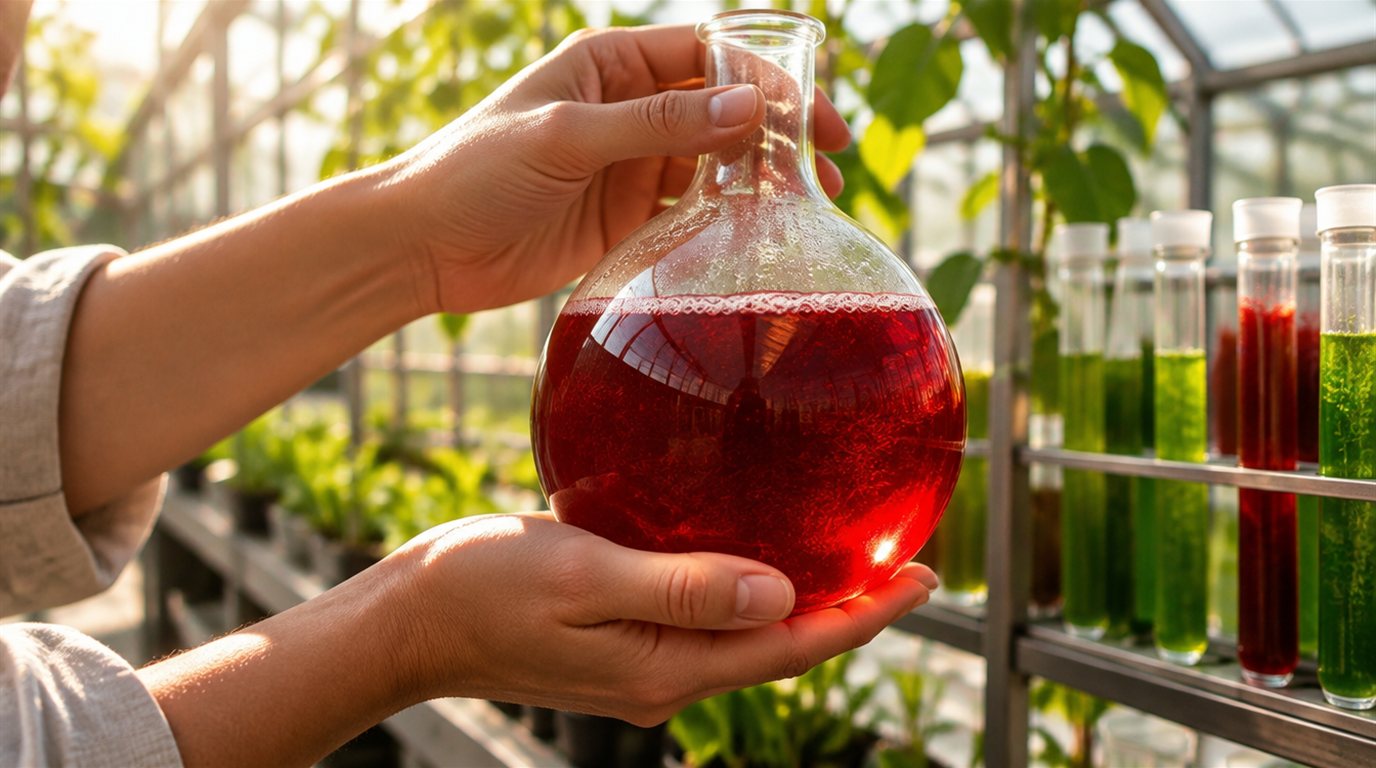
Symbolic image: AI-generated
Why is salmon pink, anyway?
The fish does not make that colour itself. It comes from its food: tiny algae produce a red pigment, krill and small crustaceans eat the algae, and salmon eat the krill. At the end of that chain is the pink fillet on your plate.
That pigment is called astaxanthin, and the internet has plenty to say about it. Here you get the facts instead: where it comes from, how much is where and what the EU allows. Figures rather than promises.
What is astaxanthin?
Astaxanthin is a carotenoid, part of the same family of natural pigments as the beta-carotene in carrots. It is fat-soluble and deep red. Its best-known source is the freshwater microalga Haematococcus pluvialis.
It was not discovered in algae, though. In 1938 the researchers Richard Kuhn and Nicolaus Sörensen first isolated it from lobster shells. The name is a reminder of that: Astacus is the crayfish genus.
In German the alga is known as the "blood rain alga", and you can see why. While conditions are good, it stays green. When life gets harder, through strong sun, drought or a lack of nutrients, it forms a thick shell and stores large amounts of astaxanthin, several per cent of its dry weight depending on strain and cultivation. It turns red, and small puddles look as if blood had dripped into them.
For food supplements, the alga is cultivated in glass tubes or ponds and encouraged to turn red. The astaxanthin is then extracted, often with supercritical carbon dioxide.
In the alga and in wild salmon, the same spatial form of the molecule dominates, known as 3S,3'S. Synthetic astaxanthin is a mixture of several forms and is used mainly as a feed additive, for example for farmed salmon.
Krill eat the algae and store the pigment. That is why krill oil naturally contains astaxanthin alongside its omega-3 fatty acids.
How much is where?
The figures show why capsules get so much attention: a normal portion of fish provides only a fraction of these amounts.
Astaxanthin in milligrams
Fish: guide values that vary widely by species and origin; wild sockeye 26 to 38 mg per kg, farmed salmon 6 to 8 mg per kg (Ambati et al., Marine Drugs 2014). Maximum: Implementing Regulation (EU) 2023/1581 on the Union list of novel foods.
Good to know: In the EU, astaxanthin from this alga counts as a novel food. That is why the amount a food supplement may provide each day is set precisely: up to 8 mg from age 14, and considerably less for younger people. Our recommendations are intended for adults.
What does the research say?
There is plenty of research on astaxanthin, but much of it comes from the lab and from animal studies. Human studies are less common and usually small. These are the four areas that get the most attention:
A 2021 review identified nine controlled studies using oral intake. The groups were mostly small, the participants were largely healthy Japanese women, and many of the studies were funded by manufacturers.
A 2024 analysis combines 11 studies with a total of 346 healthy people. The studies are small, and some use 20 mg a day or more, well above the EU maximum.
Several small studies measure blood values, for example relating to oxidative stress. Reviews of them reach mixed results, and lab values say little about everyday life.
There are individual small studies, some funded by manufacturers. We did not find a robust overall analysis in our research.
How we read this: The research is interesting but far from finished. Studies look at particular groups and amounts and say nothing about an individual product. So we make no promises based on them, and compare products below by amount, source and form.
3 myths fact-checked
Myth 1"Astaxanthin is a thousand times stronger than vitamin C."
Fact: Figures like this do the rounds and come from test-tube experiments. What is measured there cannot simply be applied to the human body, which is why you will not find them used as an argument here.
Myth 2"The higher the dose, the better."
Fact: Astaxanthin has a clear upper limit: 8 mg a day from food supplements. If you take several products, add the amounts together. Combination products and krill oil can contain astaxanthin too.
Myth 3"Astaxanthin is astaxanthin."
Fact: The source matters: algae, krill or yeast, plus synthetic versions. They differ in the structure of the molecule and in what comes with it. The ingredients list shows what is inside. Our four recommendations below all name the alga as their source.
What to check when you buy
What counts is the amount in the daily dose, not the big number on the front. Do the sum if a daily dose is more than one unit.
If it says Haematococcus pluvialis, the astaxanthin comes from the alga. Krill oil comes from crustaceans, which matters if you have an allergy.
Astaxanthin dissolves in fat, not water, so some capsules already contain olive or sunflower oil. For the others, a meal is a good time to take them.
Capsule shells are plant-based or made of gelatine. If you avoid meat or dislike swallowing capsules, there are alternatives in our range.
Our recommendations
All four provide astaxanthin from the alga. They differ in amount, form and accompanying ingredients. Our number 1 is BiuAstin in the 100-capsule tub.

BiuAstin Astaxanthin Vegan 12 mg
Astaxanthin from the microalga in extra virgin olive oil, with natural vitamin E. The vegan capsule is taken only every second day, so the tub lasts about 200 days. Continuously tested for pesticides and heavy metals.

Astaxanthin 4 mg candies
A candy to suck, with astaxanthin from the alga, natural green tea flavouring and vitamin B12. Sweetened with erythritol, which can have a laxative effect in larger amounts.

VitalAstin 4 mg (300 capsules)
A softgel capsule with extra virgin olive oil and 14.9 mg of natural vitamin E. The shell is made of bovine gelatine. If you would like to try it first, there are smaller tubs of 60 and 150 capsules.

Optiolex Astaxanthin 6 mg
Extract of the alga in a plant-based capsule shell, with a short ingredients list. The tub of 60 capsules lasts two months.
Vitamin E contributes to the protection of cells from oxidative stress (VitalAstin 124% NRV per capsule). This statement refers to the nutrient, not the product.
Frequently asked questions
Where does astaxanthin come from?
The main natural source is the microalga Haematococcus pluvialis. Through the food chain, the pigment reaches krill, prawns and salmon.
How much astaxanthin is allowed per day?
For food supplements from this alga, the EU sets up to 8 mg a day from age 14, and considerably less for younger people. Follow the recommended intake on the pack and add the amounts together if you take several products.
When is the best time to take astaxanthin?
Astaxanthin is fat-soluble, so a meal with a little fat suits it well. With capsules containing oil, timing matters less. What matters more is finding a time that fits your day.
Is there astaxanthin without gelatine?
Yes. BiuAstin is vegan, Optiolex has a plant-based capsule shell and the candy needs no capsule at all. VitalAstin has a shell of bovine gelatine.
Why is BiuAstin taken only every second day?
One capsule contains 12 mg of astaxanthin. The recommended intake is therefore 1 capsule every 2 days with a meal, an average of 6 mg a day. Stick to this routine and do not take more.
What does research say about astaxanthin?
There are many lab and animal studies, but fewer and usually small human studies, for example on skin and sport. Many of them are funded by manufacturers. You will find an overview in the section on research.
What about krill oil?
Krill oil provides omega-3 fatty acids and astaxanthin together. The anatis Krill Oil Premium contains 6 mg of astaxanthin in 2 capsules. It comes from crustaceans, so it is not for people with a crustacean allergy.
Want more like this?
Every two weeks, our newsletter explains a health topic like this one: clearly, with a tip for everyday life and suitable recommendations from our range.
Note: This article is for general information and does not replace medical advice. The health claim mentioned refers exclusively to the nutrient vitamin E and its contribution to normal body functions. Food supplements are not a substitute for a balanced and varied diet and a healthy lifestyle. Do not exceed the recommended daily intake. Keep out of reach of young children.