

By Andreas | Viterna.at · Last updated: 10 September 2026 · Reading time: approx. 8 minutes
Hardly any natural substance is asked about as often in our shop as OPC from grape seeds. For some it is the "foundation" of their daily routine, for others a mystery of three letters. Time to unpack the topic thoroughly and honestly: what OPC actually is, why the grape seed of all things is so interesting, what science says about it and what it does not, how to take OPC properly and how to recognise a good product.

Symbolic image: AI-generated
What is OPC? The grape's protective shield
OPC stands for oligomeric proanthocyanidins: secondary plant compounds from the large polyphenol family. Plants produce them as their own protective shield, for instance against intense UV light. They are found most abundantly where the plant protects its most precious part: in skins, barks and seeds. The grape is the best-known example, and here is the interesting part: most of the OPC does not sit in the sweet flesh but in the seed, exactly the part we spit out when eating grapes or that is left over when juice and wine are pressed.
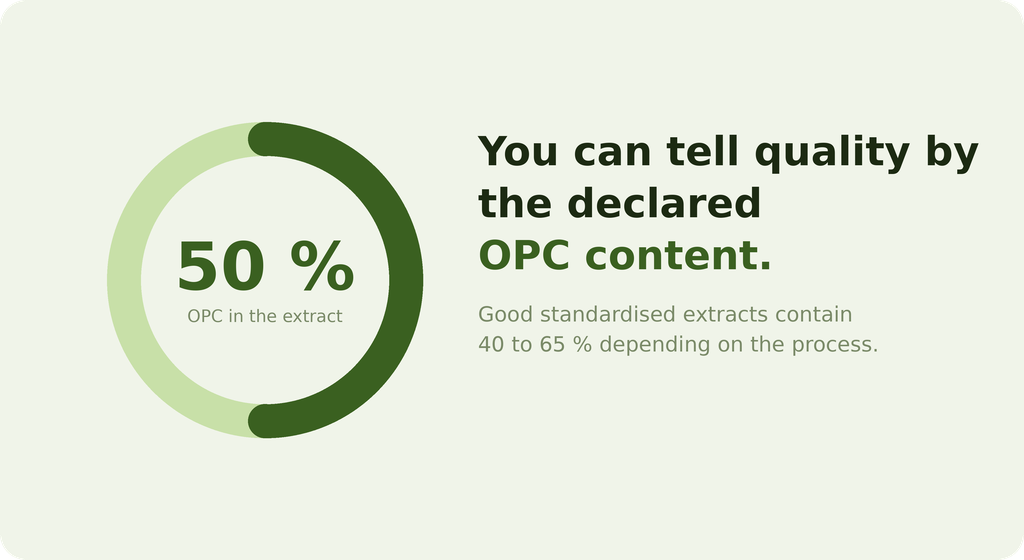
That is why food supplements use not the grape but the grape seed: the ground seeds are turned into a concentrated extract. How much pure OPC it contains is the most important quality question of all. Good manufacturers standardise their extract and state the OPC share openly; depending on the production method, 40 to 65 percent is typical.
A short history: from the peanut to the grape seed
OPC was discovered in 1948 by the French researcher Jacques Masquelier, of all places in the thin red skin of the peanut. He later detected the substance in pine bark and grape seeds as well and developed methods to obtain it from them. Grape seed polyphenols have had a long tradition in France ever since, and they still play a role in one of the best-known nutrition anecdotes of all: the so-called French paradox, the observation from the 1990s that cardiovascular complaints were comparatively rare in France despite a rich cuisine. The polyphenols in the ever-present red wine were discussed as one possible factor. Today we know the story is more complicated, and alcohol is the worst imaginable "nutrient source" anyway. But the focus on the polyphenols themselves remained, and with it the interest in their concentrated source: the grape seed.
By the way: bioflavonoids, which OPC belongs to, appeared in the older literature under the name "vitamin P". The term was dropped again because they are not vitamins in the true sense. Your body cannot produce them itself, but it does not strictly need them to survive either. They belong to the substances that a plant-rich diet simply brings along.
What does science say? An honest look
OPC is one of the most studied plant compounds, and yet with hardly any other topic is the gap between internet promises and official assessment as wide. So let us sort this out properly:
Well established: in laboratory tests, OPC shows a remarkably high antioxidant capacity, meaning the ability to neutralise free radicals. This is also where the often-quoted comparison with vitamins C and E comes from. There is also a whole series of smaller human studies on grape seed extract with mixed results; the EU has not derived any health claim from them so far.
Just as clear: there is currently no EU-authorised health claim for OPC. The assessment of plant-compound claims has been on hold for years; this affects almost all "botanicals" from artichoke to green tea. So the only honest statement is: the research is active and exciting, but nobody may or should make promises here. Anyone selling you OPC as a miracle cure for specific diseases is not a good advisor.
There is nevertheless one officially recognised anchor, via a clever companion: vitamin C. Authorised statements for vitamin C include "contributes to the protection of cells from oxidative stress" and "contributes to normal collagen formation for the normal function of blood vessels and skin". This is why well-designed OPC products combine the extract with natural vitamin C right away, for example from the camu camu fruit.
Three myths fact-checked
"OPC is 20 times stronger than vitamin C." This figure comes from laboratory comparisons of antioxidant capacity in the test tube. Such values cannot be transferred one to one to the body, where absorption, distribution and metabolism have their say. In short: impressive lab numbers, but no licence for health promises.
"Then I'll just drink red wine." The OPC content of wine varies widely and is comparatively low, and on top of that comes the alcohol, whose harms outweigh any possible benefit. If you want polyphenols from food, dark berries, grapes eaten with their seeds, nuts and green tea are the far better route.
"More is better." With OPC the opposite of an arms race applies: typical daily amounts are around 100 to 300 mg of OPC depending on the product. More is not automatically better; what counts is quality, regularity and taking it the right way.
How to take OPC properly
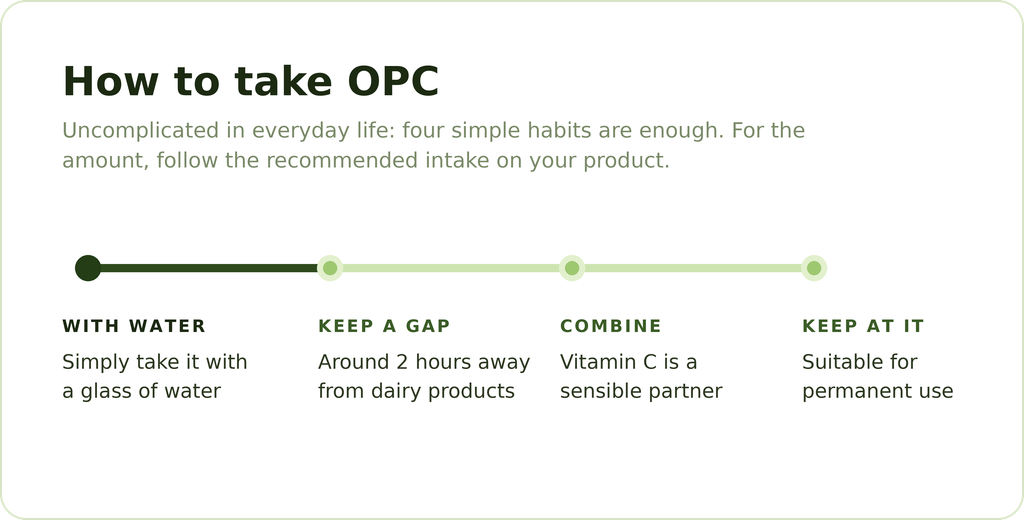
Taking OPC is uncomplicated, but a few habits make a difference:
- Take it with a glass of water. The easiest way is to make OPC a fixed part of your morning or evening routine. If you have a sensitive stomach, take it with or shortly after a meal.
- Keep a gap to dairy products. Polyphenols like to bind to protein, especially milk protein. Around two hours between OPC and your latte, yoghurt or cheese sandwich is a good rule of thumb so that as much OPC as possible arrives where it should.
- Combine it with vitamin C. Whether as a combination product or through your diet: vitamin C is the officially recognised partner when it comes to cell protection and collagen formation.
- Keep at it. OPC is suitable for permanent use. For the amount, simply follow the recommended intake on your product.
Two groups should seek advice before taking it: anyone on blood-thinning medication should discuss OPC with their doctor or pharmacist first, as interactions are possible. And during pregnancy and breastfeeding we advise against concentrated extracts due to the lack of sufficient data. Here the rule is: grapes yes, extract no.

Symbolic image: AI-generated
Which OPC suits you?
OPC is not just OPC: products differ in extract share, dosage, companion nutrients and form. Here is how to find your way around our range:
- Our recommendation, high-dose with vitamin C: The Optiolex OPC capsules (60 caps) deliver 250 mg of OPC per capsule from an extract standardised to 50 %, plus natural vitamin C from the camu camu fruit, which contributes to the protection of cells from oxidative stress. Just four ingredients, vegan, one capsule a day, and the tiered pricing makes it cheaper from 3, 6 and 10 jars. Want to go deeper? Our detailed Optiolex OPC page has all the details and bundles.
- The community classic: Robert Franz OPC 65 (60 caps) relies on a particularly highly standardised extract: 65 % OPC share, 227.5 mg per capsule, unchanged recipe for years. Tiered prices from 3, 6 and 10 units here as well.
- The combination with Q10: The anatis Grape Seed OPC + Coenzyme Q10 capsules (90 caps) combine 120 mg of grape seed extract (50 % OPC) with 80 mg of plant-based Q10 per daily dose, free from fillers and hand-encapsulated in Austria.
- Powder for stirring or filling your own capsules: For anyone who prefers flexible dosing or wants to save money: the Vital OPC Grape Seed Extract powder (300 g) with at least 45 % OPC, and the Robert Franz OPC powder (500 g) as a large stock pack. Simply stir into water or fill your own capsules.
- With berry power in organic quality: Espara Aronia-OPC ORGANIC (60 caps) combines organic grape seed extract from France with organic aronia from Germany, packed in glass.
- With resveratrol: Espara OPC-Resveratrol (30 caps) unites OPC from grape seeds and pine bark with resveratrol, lycopene and 20 mg of natural vitamin C, which contributes to normal collagen formation for the normal function of blood vessels.
- For reading up: Straight from the source: the book "OPC – Das Fundament menschlicher Gesundheit" by Robert Franz, 130 pages (German language).
- From the outside: The Robert Franz Hyaluron Cream with OPC (50 ml) brings grape seed extract and hyaluronic acid into skincare for dry and stressed skin.
Frequently asked questions about OPC
How much OPC per day is typical?
Depending on the product, recommended intakes are around 100 to 300 mg of OPC daily. What matters is not a record amount but a properly standardised extract and regularity. Follow the recommendation on your product.
Can I take OPC permanently?
Yes, OPC is suitable for permanent, regular use within the recommended intake. It is not a course product that would have to be stopped after four weeks.
Why should I not take OPC with milk?
Polyphenols like OPC bind to protein, especially milk protein. Part of the OPC is then no longer available to the body. So take OPC with water and keep around two hours between it and dairy products.
Isn't it enough to eat grapes or drink red wine?
Grapes with their seeds, dark berries and nuts provide polyphenols and are always a good idea. But you can hardly reach the OPC amount of a concentrated extract through food, and red wine is ruled out as a sensible source because of the alcohol.
How do I recognise a good OPC product?
By the transparently declared OPC share of the extract (40 to 65 % is typical), by a clear statement of how much pure OPC each capsule or portion contains, and by a short ingredient list without unnecessary additives.
Who should seek medical advice before taking it?
Anyone taking blood-thinning medication should clarify OPC with their doctor first, as interactions are possible. During pregnancy and breastfeeding we advise against concentrated extracts, as the data is not sufficient.
Conclusion: a classic, honestly explained
OPC from grape seeds is one of the most fascinating plant compounds there is: a long research history, impressive lab results, a loyal following and an active scientific field. Honesty also means saying: officially authorised health claims for OPC do not exist yet. If you are curious, the best way to start is a properly standardised extract, taken with water and a little distance from milk, cleverly combined with vitamin C, and then simply keep at it. Exactly how we like it with natural substances: no miracle promises, but a good feeling.
More knowledge like this?
Every two weeks our newsletter explains a health topic like this one: easy to understand, with a tip for everyday life and matching recommendations from our range.
Note: this article is for general information and does not replace medical advice. Food supplements are no substitute for a balanced and varied diet and a healthy lifestyle.