By selecting "Accept all", you give us permission to use the following services on our website: Strictly necessary cookies, YouTube, Vimeo, ReCaptcha, Google Analytics, Google Ads, Google Tag Manager, Brevo, Meta Pixel, PayPal Express Checkout und Ratenzahlung. You can change the settings at any time (fingerprint icon in the bottom left corner). For further details, please see Individual configuration and our Privacy notice.
The settings you specify here are stored in the "local storage" of your device. The settings will be remembered for the next time you visit our online shop. You can change these settings at any time (fingerprint icon in the bottom left corner).
For more information on cookie lifetime and required essential cookies, please see the Privacy notice.
To view YouTube contents on this website,
you need to consent to the transfer of data and storage of third-party cookies by
YouTube (Google).
This allows us to improve your user experience and to make our
website better and more interesting.
Without your consent, no data will be transferred to YouTube.
However, you will also not be able to use the YouTube services on this website.
To view Vimeo contents on this website, you need to consent to the
transfer of data and storage of third-party cookies by Vimeo..
This allows us to improve your user
experience and to make our website better and more interesting.
Without your consent, no data will
be transferred to Vimeo. However, you will also not be able to use the Vimdeo services on this website.
To submit forms on this page, you need to consent to the transfer of data and storage of third-party cookies by Google.
With your consent, reCAPTCHA, a Google service to avoid spam messages via contact forms, will be embedded.
This service allows us to provide our customers with a safe way to contact us via online forms. At the same time, the service prevents spam bots from compromising our services.
After you gave your permission, you might be asked to answer a security prompt to send the form.
If you do not consent, unfortunately you cannot use the form. Please contact us in a different way.
This is a web analysis service. It allows the user to measure advertising return on investment (ROI) and track user behavior. Data collected: anonymized IP address, date and time of visit, usage data, click path, app updates, browser information, device information, JavaScript support, pages visited, referrer URL, location information, purchase activity, widget interactions.
This is an advertising service. This service can be used to display personalized or non-personalized advertising to users. With Google Ads Conversion Tracking, we can measure our advertising success in the Google advertising network. We place advertisements in the Google advertising network so that our offers can be found more easily. We try to optimize our advertising as much as possible. Also to keep advertising costs as low as possible. This is reflected in our prices.
This is a tag management system. The Google Tag Manager allows tags to be integrated centrally via a user interface. Tags are small sections of code that can track activities. Script codes from other tools are integrated via the Google Tag Manager. The Tag Manager makes it possible to control when a specific tag is triggered.
To send data to Brevo, you need to consent to the transfer of data and storage of third-party cookies by Brevo. This allows us to improve your user experience and to make our website better and more interesting.
To send data to Meta, you need to consent to the transfer of data and storage of third-party cookies by Meta.. This allows us to improve your user experience and to make our website better and more interesting.
In order to unlock offers for extended payment options, in particular express checkout and payment in instalments, we require your consent to the data transfer and storage of third-party cookies of the payment provider PayPal. This allows us to also offer you express checkout and payment by instalments. Without your consent, only the technically necessary data transfer to PayPal will take place, but you will then not be able to use the express checkout or extended offers for payment by instalments on this site.
Description:
Using express checkout and Displaying offers for payment in instalments for individual items or your entire purchase.
Would you like to see these contents? Activate the desired contents for one session only or allow the website to remember these settings. Once you have given your consent, the third-party data can be loaded. For this, third-party cookies might be stored on your device. You can change these settings at any time (fingerprint icon in the bottom left corner). For further details, please see the Privacy notice.
Nutrients for children in a child-friendly form: juices, drops and pastilles with vitamin D, iodine, calcium, iron and vitamin C. Vitamin D is needed for normal growth and development of bone in children. Read the guide below to see what matters at which age. Read the guide ↓
Between their first birthday and their final school exams, a child grows by a good metre.
Every centimetre needs building blocks: calcium and vitamin D for the bones, iodine for growth, iron for cognitive development. The biology is the same as it was fifty years ago, only everyday life has changed: less time at the family table, more ready meals, more screen time and hardly any sun in winter.
Here you can find out which nutrients often run low at which age, which claims the EU has authorised specifically for children and how the children's juices, drops and pastilles in our range differ.
Symbolic image: AI-generated
Four stages of growth, four priorities
Children are not small adults. Up to their second birthday they grow 10 to 12 centimetres a year, and during puberty up to 10 centimetres a year once again. With every stage, the nutrients that matter most shift. Vitamin D and iodine often run low in all age groups, calcium joins them in schoolchildren and teenagers, and iron in girls from puberty onwards.
60 : 4
per cent: parents want raw veg in the snack box, children actually buy it
20 µg
vitamin D a day from 1 year, without sun on the skin
1,200 mg
calcium a day for teenagers
10 to 18
years: the period when most bone mass is built
Good to know: From October to March, the sun in Austria is too low for the skin to make any real amount of vitamin D. From food alone, children get only a small part of the 20 µg that the D-A-CH reference values state for this time.
What children are missing today, what the snack box check reveals and how to recognise a child-friendly supplement is explained in detail in our blog guide What children need to grow up healthy.
Nutrients with an EU-authorised claim
The EU has assessed and authorised claims specifically for children. The quotations are the official claims word for word. Below each one you will see where the nutrient is found in food and when it tends to run low.
Vitamin D
“Vitamin D is needed for normal growth and development of bone in children.”
Recommended a day: 20 µg from 1 year when the skin makes none of its own
Found in: oily sea fish, eggs, mushrooms
Calcium
“Calcium and vitamin D are needed for normal growth and development of bone in children.”
Recommended a day: 600 mg at 1 to 3 years, rising to 1,200 mg
Found in: milk, cheese, broccoli, calcium-rich mineral water
Iodine
“Iodine contributes to the normal growth of children.”
Recommended a day: 100 µg at 1 to 3 years, rising to 200 µg
Found in: iodised salt, sea fish, dairy products, eggs
Iron
“Iron contributes to normal cognitive development of children.”
Often low: in toddlers, in girls once their periods start, on a meat-free diet
Found in: meat, oats, millet, lentils, pumpkin seeds
Zinc
“Zinc contributes to normal cognitive function.”
Often low: in teenagers and when little wholegrain or meat is eaten
Found in: oats, cheese, meat, pumpkin seeds
Vitamin C
“Vitamin C contributes to the normal function of the immune system.”
Recommended a day: 20 mg at 1 to 3 years, rising to around 100 mg
Found in: peppers, broccoli, kiwi, citrus fruit, acerola
Magnesium
“Magnesium contributes to the maintenance of normal bones and teeth.”
Often low: in schoolchildren and teenagers who eat little wholegrain
Found in: wholegrains, oats, nuts, pulses
Vitamin K
“Vitamin K contributes to the maintenance of normal bones.”
Good to know: often combined with vitamin D in a single drop
Found in: green leafy vegetables, cabbage, sauerkraut, cheese
Children's supplements compared: which one suits your child?
These four supplements are made for children and cover several nutrients at once. The boxes show at a glance how much vitamin D, iodine, zinc and vitamin C a daily serving provides.
Vitamin D is needed for normal growth and development of bone in children (all four). Iodine contributes to the normal growth of children, and iron contributes to normal cognitive development of children (Body Basic Omega+, Kids vitamins). Vitamin C, vitamin D and zinc contribute to the normal function of the immune system (Body Basic Omega+, Kinder-Fit, Kids vitamins).
Targeted top-ups: one nutrient, one bottle
If only one building block is missing, a single supplement is often all you need. These products can be dosed by age or are made for the whole family.
1 chewable tablet with 200 mg vitamin C and 2 mg zinc. For: children who would rather chew than swallow.
Three myths that refuse to go away
Myth 1
“A glass of fruit juice is as good as a piece of fruit.”
Fact: Juice has lost its fibre, yet it packs the fruit sugar of several fruits into one glass. Water as the main drink and fruit to bite into make the better combination.
Myth 2
“In summer my child stocks up on vitamin D for the winter.”
Fact: The body can only store a limited amount of vitamin D. From October to March, the skin in Austria makes hardly any more, which is why many families keep vitamin D in mind all year round, especially in these months.
Myth 3
“Half an adult tablet will do just as well.”
Fact: Children need different amounts and have their own upper limits. Children's supplements are made for exactly that: with an age guideline, the right dose and a form children are happy to take.
Good to know when giving supplements
✓
Check the age guideline
Every children's supplement states the age it is intended for and how much to give. The Dr. Wunder drops are intended from 1 year, Body Basic Omega+ and Kinder-Fit from 3 years.
✓
Add up instead of doubling up
Vitamin D is often found in several products. EFSA sets the tolerable upper intake level from all sources at 50 µg a day for children aged 1 to 10 and 100 µg from 11 years. Add everything up before you combine.
✓
Make it part of breakfast
Vitamins D and K are fat-soluble and go well with a meal containing a little fat, such as bread and butter, yoghurt or muesli with milk. If you keep the bottle next to the breakfast plate, you are less likely to forget it.
✓
You measure, your child takes it
Children's supplements also belong out of the reach of children. Keep juices in the fridge once opened and check the shelf life on the label, which for Body Basic Omega+ is 4 weeks.
Vitamin D and iodine in all age groups, plus calcium in schoolchildren and teenagers, and iron in toddlers and in girls during puberty. Vitamin D is needed for normal growth and development of bone in children.
From what age can my child take vitamin D drops?+
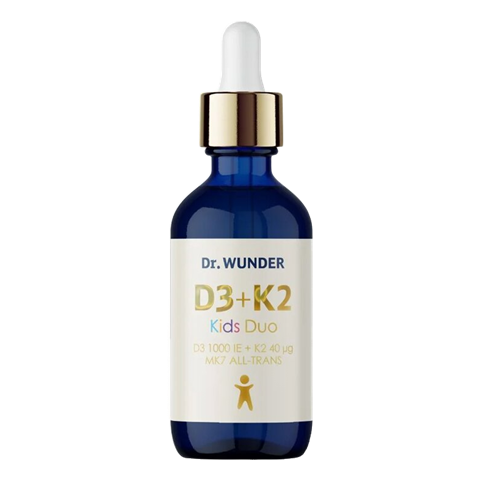
You will find this on the label. The Dr. Wunder D3 + K2 Kids Duo drops are intended from the first birthday, and one drop a day provides 25 µg vitamin D3 and 40 µg vitamin K2.
What is the difference between Kinder-Fit and Body Basic Omega+?+
Kinder-Fit is the classic Cosmoterra recipe for children from 3 years, with vitamins and trace elements. Body Basic Omega+ is intended from 3 years and for the whole family, and also contains linseed oil, calcium, magnesium, iron and iodine.
My child will not swallow tablets. What are the options?+
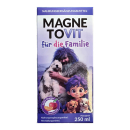
Juices by the spoonful such as Kinder-Fit and Body Basic Omega+, drops for yoghurt or muesli, liquids to measure out such as Jodavit and Magnetovit, plus chewable tablets and pastilles to suck.
How much iodine does a child need?+
The D-A-CH reference values state 100 µg a day for children aged 1 to 3, rising to 200 µg for teenagers. Iodine contributes to the normal growth of children. Good sources are iodised salt, sea fish and dairy products.
Are there vegan supplements for children?+
Yes. Body Basic Omega+ is vegan, with its omega-3 coming from linseed oil. The Dr. Wunder D3 + K2 Kids Duo drops contain vitamin D3 from lichen.
In short
For every centimetre, children need the same building blocks as they always have, but everyday life makes it harder to get them all onto the plate. The EU has authorised claims specifically for children for vitamin D, calcium, iodine and iron. Family meals, exercise and sleep remain the foundation, and a child-friendly supplement fills the gaps in between.
KEY POINTS
Keep vitamin D in mind all year round.
Iodised salt in the kitchen, calcium above all between 10 and 18 years.
Child-friendly means: an age guideline, the right amount and a form your child likes.
Add up the amounts from all products.
Note: Health claims refer exclusively to the nutrients named and comply with Regulation (EU) No 432/2012 and Article 14 of Regulation (EC) No 1924/2006. Reference values according to D-A-CH, snack box figures according to Snack5 / Inquest Institute Sieber (Austria, 2020). Food supplements are not a substitute for a varied, balanced diet and a healthy lifestyle. Do not exceed the recommended daily intake. Keep out of the reach of young children.