

By Andreas | Viterna.at · Last updated: 27 August 2026 · Reading time: approx. 6 minutes
When the word creatine comes up in our shop, many people first think of bodybuilders and big tubs from the gym. Yet creatine is something very ordinary: your body makes it itself, it sits in every muscle you have, and it delivers the energy for every short, powerful movement. From getting up out of an armchair to sprinting for the bus. In this article we explain what creatine does in your body, who might find taking it interesting and how the intake works. And we clear up a few stubborn myths along the way.

Symbolic image: AI-generated
What is creatine?
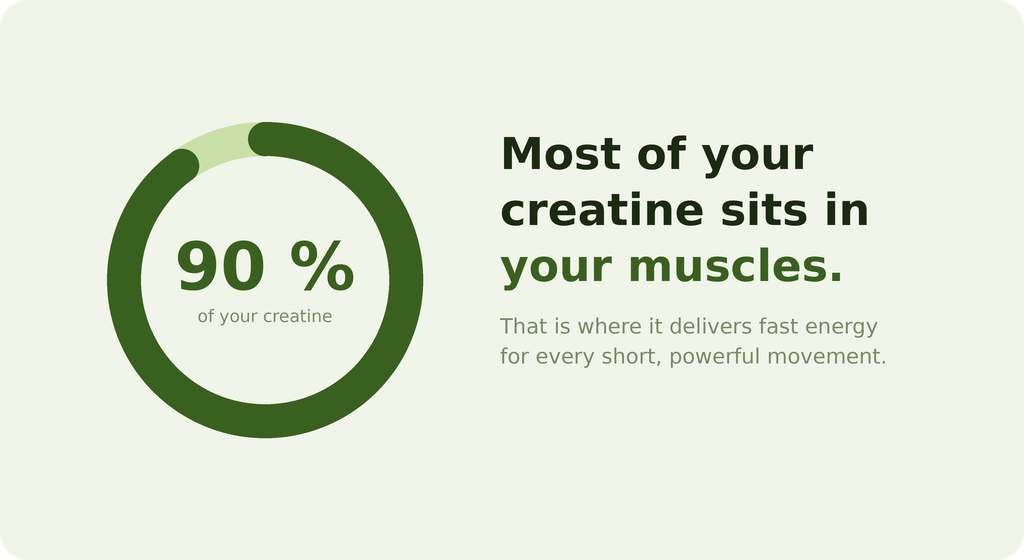
Creatine is not an artificial substance from a lab but something your body makes itself. It assembles it in the liver, kidneys and pancreas from three amino acids, about one gram per day. On top of that you take in creatine through food, mainly through meat and fish. Together this fills a reserve that is stored almost entirely, around 90 %, in your muscles.
How full this store is differs from person to person. If you regularly eat meat and fish, you take in creatine every day. For perspective: 100 grams of meat or fish contain roughly 0.5 grams of creatine. If you eat a vegetarian or vegan diet, you usually start with lower stores, because plant foods contain practically no creatine.
What does creatine do in your body?
Your muscles keep their own energy buffer for fast movements: creatine phosphate. Whenever you need a lot of strength in the first seconds of an effort — climbing the stairs with shopping bags, lifting a crate of drinks, a circuit-training set — this buffer kicks in before other energy sources get going. The fuller your creatine stores, the longer the buffer lasts.
This is exactly what the officially authorised statement of the European food authority refers to: creatine increases physical performance in successive bursts of short-term, high-intensity exercise. The condition is a daily intake of 3 grams. That is not an advertising line but one of the few sentences that may legally be said about creatine in Europe, because the evidence supports it. Creatine is among the most thoroughly studied food supplements there are.
Who is creatine interesting for?
In short: for everyone who challenges their muscles or wants to keep them. A few groups pay particularly close attention:
- People whose sport involves short, intense efforts. Strength training, ball sports, interval training. Here creatine has been a standard for decades.
- People who eat a vegetarian or vegan diet — or simply little meat and fish. They take in hardly any creatine through food and start with lower stores; a supplement can make itself felt all the more clearly. Good to know: creatine monohydrate in supplements is produced without animal raw materials, so it is suitable for vegans too.
- Adults over 55 who work on their strength. There is a separate officially authorised statement for this too: a daily intake of 3 grams of creatine can enhance the effect of regular resistance training on muscle strength. The condition is training at least three times a week over several weeks. So creatine does not replace the training, it supports it.
- Seniors who want to stay independent and mobile. From around 65, natural muscle loss speeds up noticeably — and that is exactly when every bit of preserved muscle counts, from walking safely to getting up out of a chair. The authorised statement "over 55" naturally applies at 70 or 80 as well. And resistance training does not mean the weight bench: regular bodyweight exercises, resistance-band work or consistent stair climbing count too.

Symbolic image: AI-generated
And yes: all of this applies to women just as much as to men. Creatine is not a "men's supplement" — the energy buffer in the muscle works the same way in everyone.
Four myths, fact-checked
"Creatine is doping." No. Creatine is a normal component of food, appears on no banned list and is freely available as a food supplement.
"It bloats you." Creatine binds water — but inside the muscle itself, not under the skin. A slight weight gain of a few hundred grams up to about one kilo is possible and normal. That is water in the muscle, not body fat.
"You have to start with a loading phase." You don't. The loading phases of the past, 20 grams a day, do fill the stores faster but more often cause digestive discomfort. With 3 grams daily your stores are just as full after 3 to 4 weeks, only without the side effects.
"Creatine harms your kidneys." In healthy adults, long-term studies show no harmful effects even over years. What is true: the lab value creatinine can rise slightly while you take it. That is merely the breakdown product of creatine and no sign of impaired kidney function. Simply mention that you take creatine at your next blood test. If you have an existing kidney condition, please discuss the intake with your doctor first.
Taking creatine: how it works
The intake is uncomplicated, and that is the most important news:
- 3 grams per day — the amount the authorised statements refer to, and at the same time the recommended daily amount for food supplements.
- The form: The standard is creatine monohydrate, by far the best-studied form. Branded raw materials such as Creapure® stand for tested purity made in Germany.
- The timing does not matter. Into your water or juice in the morning, into your coffee or muesli — the main thing is every day. Tie the intake to an existing habit and you won't forget it.
- Patience for 3 to 4 weeks. That is how long it takes for the stores to fill. Creatine does not work like an espresso from minute one — it works through the full store.
- Keep going rather than rushing courses. Creatine can be taken permanently. If you stop, your store settles back to its starting level after about four weeks.
- Drink enough — creatine draws water into the muscle.

Matching products from our range: the nutri+ Creatine Creapure® capsules with the certified Creapure® raw material made in Germany — pre-measured for everyone who prefers not to stir powder — and the Vital Creatine Monohydrate Powder (500 g, micronised and taste-neutral) for everyone who simply stirs their daily portion into water or muesli. You will find more from this range in our Sports category.
Frequently asked questions about creatine
Does creatine work without training?
The authorised statements refer to physical exertion: more performance in short, intense efforts and, over 55, support for the effect of resistance training. So creatine is no substitute for movement but its partner. The good news: "training" does not mean competitive sport. Brisk stair climbing, gardening or bodyweight exercises also call on the energy buffer in your muscles.
Do I need a loading phase?
No. With 3 grams daily your stores are full after 3 to 4 weeks. A loading phase speeds this up by only a few days and more often causes digestive discomfort.
Will creatine make me gain weight?
A gain of a few hundred grams up to about one kilo is possible. That is water bound inside the muscle, not body fat. Many people rather perceive their muscles as "fuller".
Is creatine suitable for women?
Yes, without restriction. The effect on the energy buffer in the muscle is the same in women and men. Since women on average eat less meat and have smaller stores, the supplement can even make itself felt more clearly.
Who should seek medical advice first?
People with a kidney condition as well as pregnant and breastfeeding women should discuss the intake with their doctor or pharmacist beforehand. Creatine supplements are not intended for children and adolescents.
Conclusion: an old acquaintance, rediscovered
Creatine has been in you all along. The only question is how full your stores are. If you challenge your muscles regularly, eat little meat and fish, or want to build strength past 55, then 3 grams a day gives you one of the best-studied and most uncomplicated supplements there is. No loading phase, no timing stress — just a glass of water and a little consistency.
More knowledge like this?
Every two weeks our newsletter explains a health topic like this one: clearly, with a tip for everyday life and matching recommendations from our range.
Note: This article is for general information and does not replace medical advice. Food supplements are no substitute for a balanced, varied diet and a healthy lifestyle.